EN
EN  DE
DE 

Setting the Right Goals in Triathlon
Introduction
A successful triathlon career is built on setting ambitious but attainable goals. While many experienced athletes plan their racing season well in advance, beginners often face the challenge of aligning their goals with everyday life. This article explains how a structured approach can lead to long-term success and help athletes find the right balance between training, competition, and personal life.
The Importance of Realistic Goals
Setting attainable goals is crucial to long-term triathlon performance improvement. An overly ambitious approach can lead to overuse injuries, burnout, and loss of motivation. Athletes who have already completed an Olympic-distance race should not rush into targeting a long-distance event without careful consideration. A systematic approach with gradual progression is more effective and leads to better long-term results.
Long-Term Planning Over Three Years
A well-crafted three-year plan reduces the chance of failure while enabling ongoing performance improvement.
-
First year: Establishing a strong aerobic foundation. The focus is on improving basic endurance and technical skills in swimming, cycling, and running. Sprint and Olympic-distance races help athletes gain race experience and refine their race strategy.
-
Year 2 involves the transition to longer distances and the increase in training intensity. Valuable insights into individual strengths and weaknesses are gained from the initial start of a middle-distance race. Training becomes more specifically oriented toward long-distance racing.
-
Third year: Concentrated training for a long-distance race. A refined nutrition strategy, targeted race simulations, and extended training sessions are of paramount importance. A middle-distance test race is conducted to establish a performance baseline prior to the final critical race.
By following a methodical progression, the body is guaranteed to continuously adapt to increasing training loads and achieve peak performance at the right time.
|
Triathlon Races in the Long Island Region The company brings wellness-oriented, active families to venues throughout the Long Island region. |

Realistically Assessing Time Resources
The realistic evaluation of the available training time is a critical component of successful training planning. Real time needs are frequently underestimated. Apart from the actual training sessions, recovery times, preparation time, and follow-up time must all be taken into account. Taking two hours away from the first estimate of weekly training time is a practical way to get a more accurate number.
Selecting the Key Race
When picking a key race, you should be strategic and think about a number of important things, such as:
- Logistical considerations: The athlete's personal schedule should be easily accommodated for the race.
- Family-related factors: A lot of athletes purposefully plan their major competition to coincide with the start of a family holiday to give them time to recuperate and spend time with their loved ones.
- Periodization: Care must be taken to schedule the race during the season, particularly when professional workloads are at their highest.
Annual Training Planning
A comprehensive evaluation of public holidays, bridge days, and vacation periods is necessary for an effective training year. Training camps—such as those located on Mallorca or Fuerteventura—can be strategically employed to optimize fitness and implement specific training stimuli.
Additional important aspects include:
- Climate: Athletes who intend to compete during the summer months should incorporate heat training into their training regimen at the outset.
- Individual professional requirements: In order to prevent overload, training design must account for periods of high work stress.
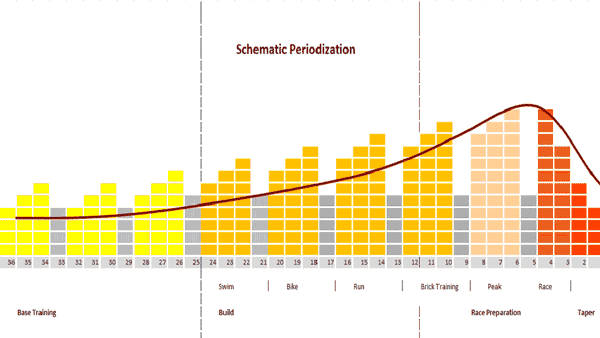
- Periodization: For long-term performance improvement, a carefully planned order of stress and recovery phases is necessary.
- Specific training interventions: The plan can be significantly enhanced by the inclusion of targeted intensity blocks or altitude training camps.
Choosing Race Distance and Number of Races
The number of races depends on individual goals and the chosen race distance:
- Middle distance (4–6 hours race time): 3–4 races per year are realistic.
- Ironman: A maximum of 1–2 races per year to avoid excessive strain.
- Olympic and sprint distance: Multiple races are possible, especially for athletes competing in league formats.
For athletes with world championship ambitions, it is essential to select the qualification race strategically. A late qualification in the previous year can be a sensible way to prepare optimally for the following season.

|
Triathlon Coaching - individual and highly effective! 
|
Race Selection Based on Geographic and Financial Considerations
Financial viability and geographic location are significant determining factors:
- Travel effort: Local competitions cut expenses and simplify planning.
- Cost considerations: Entry and travel costs are high for long-distance races.
- Professional obligations: Athletes who are employed in demanding positions should avoid scheduling races during periods of particularly intense work.
Social Aspects of Triathlon
Triathlon is not only an individual sport but also a social one. The decision to race alone or together with club teammates can influence motivation and the overall race experience. Mental Load and Recovery. In addition to physical stress, mental strain must not be underestimated. An excessively dense race calendar can lead to psychological fatigue. Thoughtful planning with sufficient recovery phases is essential.
Mental Load and Recovery
In addition to physical stress, mental strain must not be underestimated. Psychological exhaustion can result from an overly packed race schedule. Thoughtful planning with sufficient recovery phases is essential.
Conclusion
Strategic and realistic race planning is essential for a successful triathlon season. Optimizing performance development, ensuring long-term motivation and success in the sport, necessitates well-founded goal setting, intelligent periodization, and forward-thinking planning.